


 Bet sizing is one of the most important skills in poker. Knowing how many chips to put into a pot is the only way you get maximum value from your strong hands. It’s also the only way to make profitable bluffs.
The good news is that there are formulas you can use to calculate the best bet size for every situation. I’ll show you what they are, as well as the things you need to consider before you commit your chips. So, if you’re ready, let’s get started.
Why Bet Sizing Matters in Poker
There are two reasons bet sizing matters in poker:
1. Bet sizing affects the ways opponents react
The most effective way to win pots in poker is by taking the betting lead. I talk about this in my guide to mastering aggression in poker. Taking the betting lead gives you a chance to control opponents. If you want them to call or fold, you can size your bets accordingly.
For example, betting 100% of the pot’s value is a sign of strength. In this situation, tight opponents and those with weak hands are likely to fold. If, however, you bet 33% of the pot’s value, it’s less scary. Betting this much might tempt tight opponents and those with weak hands to call.
As always, there’s more than one right answer. A small bet can look strong in the right situations. However, in general terms, big bets look strong and small bets look weak. Based on this, you can size your bets according to the outcome you want. If you want someone to call, make a relatively small bet. If you want them to fold, make a bigger bet.
The point here is that bet sizing puts your opponent in a position where they need to respond. Essentially, bets are like questions. You’re asking an opponent if they want to fold, call, or raise. Taking the betting lead and putting the perfect number of chips into the pot allows you to get the answers you want.
2. Bet sizing impacts your actions on future streets
Bet sizing in poker also affects what happens on later streets. Consider this scenario:
- You’re playing Texas Hold’em.
- You get to the flop, and there are 50 chips in the pot.
- You’ve got 100 in chips.
- You bet 50 chips, and your opponent calls.
At this point, the pot is 150 chips, and you have 50 left. Even if you go all-in, the amount you’re betting only equates to 33% of the pot’s value. If you check and your opponent bets 50 chips, you probably have to call because of the risk-to-reward ratio. In other words, the amount you stand to win is better than the amount you’re risking.
The point to take from this example is that betting 50 chips on the flop meant you were almost required to either move all-in or call an all-in bet on the turn/river. In poker, we call this being pot committed. It simply means you’ve put so many chips in the pot that folding would be a mistake.
That’s why the amount you bet affects what happens on future streets. You need to consider your chip stack and the size of the pot before thinking about other variables, such as whether you want someone to call or fold.
It’s never a good idea to be pot committed with weak or middle-strength hands. So before you bet, think about whether you’re willing to risk more chips on a later street. If you’re not, either make a small bet or check.
Stack-to-Pot Ratio
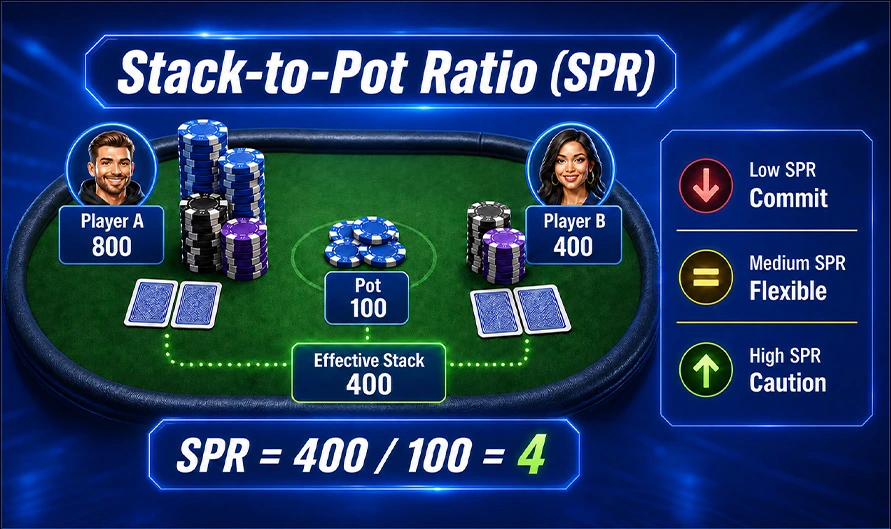 Closely tied to the concept of being pot committed is stack-to-pot ratio (SPR). Poker players use SPR as a measure of risk and reward. It provides a measure of how strong hands must be to move all-in based on the effective stack and pot size.
- The calculation for stack-to-pot ratio is: effective stack/size of the pot
The effective stack is the smallest of the stacks at risk. For example, if Player A has 100 chips and Player B has 300 chips, the effective stack is 100 chips. That’s because you can’t risk more chips than you have. Therefore, the smallest stack determines how many chips are up for grabs.
Here’s an example of how to calculate SPR in an all-in situation before the flop:
- Player A = 800 chips
- Player B = 400 chips
- Pot = 100 chips
Calculation
- The effective stack is 400 chips
- The pot is 100 chips
- The SPR 400 / 100 = 4
The SPR tells us how strong our hand needs to be. The higher the SPR, the stronger your hand needs to be. There is a way to use equity and SPR together to determine whether a call is theoretically profitable.
However, for that, I need to get into the nuances of ranges, equities, and pot odds. So, to keep things simple, I’ve put together an SPR cheat sheet. The table below gives you a basic guide to SPR and when it’s OK to call all-in bets:
| SPR Value | Suggested Move | Types of Hands |
|---|---|---|
| 0 to 3 | Call all-in bets with most hands — anything better than a pair | |
| 3 to 6 | Call all-in bets with strong hands — anything better than two pair | |
| 6+ | Only call all-in bets with your very best hands — anything better than a straight |
Summary: Bet Sizing Affects the Present and the Future
What I want you to take from this section is that bet sizing affects what happens in the present and the future. In the present, opponents react based on the amount you bet. If your bet looks scary, they’ll probably fold unless they’ve got a strong hand. If your bet looks weak, they’ll probably call.
The amount you bet also affects what you can do on later streets. If you bet an amount that leaves you with a handful of chips, it will be hard to bluff on later streets. Conversely, if you’ve got a strong hand and want maximum value, betting a lot on one street can help you get more chips into the pot on later streets.
Standard Bet Sizes in Poker
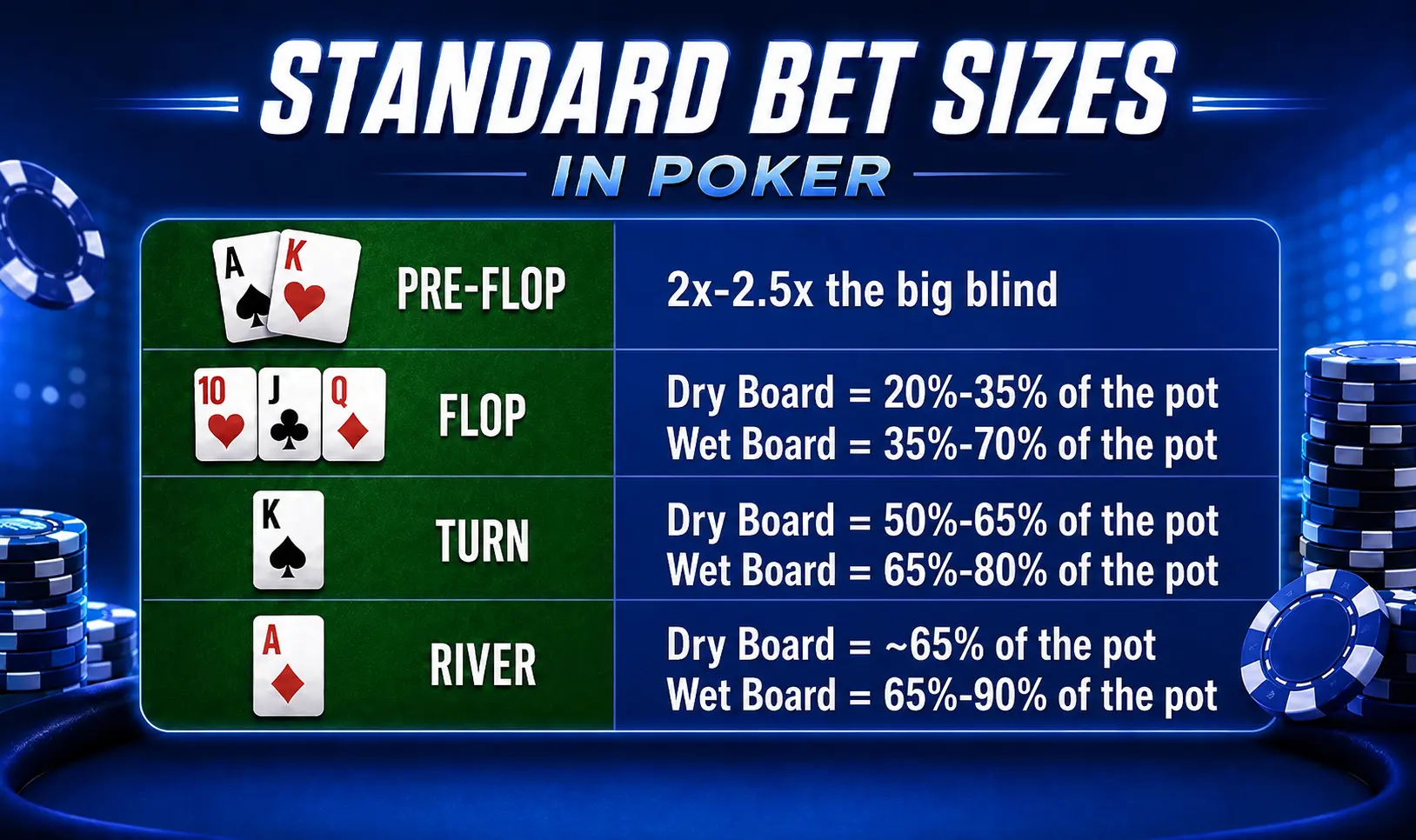 Because bet sizing is so important, skilled poker players have identified which amounts have the greatest impact on different streets. These amounts have changed slightly over the years, so I prefer to talk in ranges rather than absolutes.
Here are the standard bet sizes for Texas Hold’em:
Pre-flop bet sizes:
- 2x-3x the pot
Post-flop bet sizes:
Standard post-flop bet sizes vary based on board texture. Boards (aka the community cards) can be described as dry and wet:
- Dry boards consist of unconnected cards, which means there aren’t any/many possible draws. An example of a dry board is: A♣ 6♥ 9♠.
- Wet boards consist of connected cards, meaning there is one or more possible draws. An example of a wet board is: A♣ J♣ 10♥.
The general rule is that you need to bet slightly more on wet boards than dry ones. The justification for betting more is to charge players for chasing draws. Essentially, you’re protecting your hand by making it more expensive for someone to hit their draw.
Now that’s clear, here are some standard bet sizes for dry and wet boards in Texas Hold’em:
The Flop
- Dry boards = 20%-35% of the pot’s value as a standard continuation bet
- Wet boards = 35%-70% of the pot’s value to protect made hands/bluffs
The Turn
- Dry boards = 50%-65% of the pot’s value with made hands
- Wet boards = 65%-80% of the pot’s value to protect made hands/bluffs
The River
- Dry boards = approximately 65% of the pot’s value with made hands
- Wet boards = 65%-90% of the pot’s value with made hands/bluffs
Please note that the percentages will be different for other variants, including Pot Limit Omaha. They should also be used as a guide. Poker is about putting people in tough spots. Therefore, it’s OK to play around with your bet sizing to confuse people.
A Note on 3-Bet Pots
Standard continuation bets in 3-bet pots should be slightly smaller because you don’t want to be pot committed too early in the hand. Of course, there will be times when you want to be pot committed with very strong hands.
However, when you’re bluffing, semi-bluffing with draws, or have a medium-strength hand, it’s better to be towards the bottom end of the range. So, on dry boards, 20% of the pot’s value is OK. On wet boards, 35% is acceptable.
A Note on Turn Betting
Betting on the turn can be difficult due to something known as polarization. In poker, polarization means your hand looks like it’s within one of two categories: really strong or really weak.
The turn is when hands start to become polarized. For example, let’s consider the following situation:
- The board = A♣ 4♣ 9♥ 8♣
- The pot = 400 chips
- You bet 350 chips
In this spot you’re telling your opponent one of two things here:
- I’m betting big because I’ve got a flush and I want to protect my hand
- I’m betting big because I’m bluffing and want you to think I’ve got a flush
Your hand is polarized because you’ve made such a big bet. This actually makes it slightly easier for your opponent to make a decision because they only have to decide if you’ve got a flush or you haven’t.
If, instead of making a big bet, you used a more conventional amount for wet boards (65%-80% of the pot’s value), it wouldn’t be as polarizing. This would make it harder for your opponent to know if you’re value betting or bluffing because there are a variety of hands you could have.
For instance, if you bet 70% of the pot’s value, you could have a flush, a pair of aces, two pair, or a straight draw. You could also be bluffing. That’s more options than if you polarize your range, which is why it’s important to think about what message your bet sends to someone.
Rules Are Made to Be Broken: Exploitative Adjustments
There are times when you can and should stray from standard bet sizing. Doing this confuses your opponents, which, in turn, makes you harder to play against. For example, we know the standard continuation bet on dry flops is 20%-35% of the pot’s value.
You should stick to this range most of the time with value bets and bluffs. However, I also recommend throwing in bigger bets every once in a while. Let’s say you flop a strong hand, such as a set.
Instead of taking the conventional line, you could bet 100% of the pot’s value. Skilled players will notice that this is an unusual bet. From this, they may decide that it’s a suspicious bet that looks like a bluff. If that’s the case, you’ll get more value from strong hands like sets.
This strategy won’t work all the time, and it can get you into trouble when things go wrong. But if you use it sparingly, breaking the rules and going against convention can be profitable.
The same goes for overbetting. There are times when it’s OK to bet more than the pot’s value. This polarizes your range, which isn’t ideal in most situations. However, there are times when it can be useful. Poker is all about learning the rules and breaking them when it’s suitable. In other words, you set conventions and exploit them. This makes you a much tougher person to play against.
Pot Odds in Poker: Value Betting and Bluffing
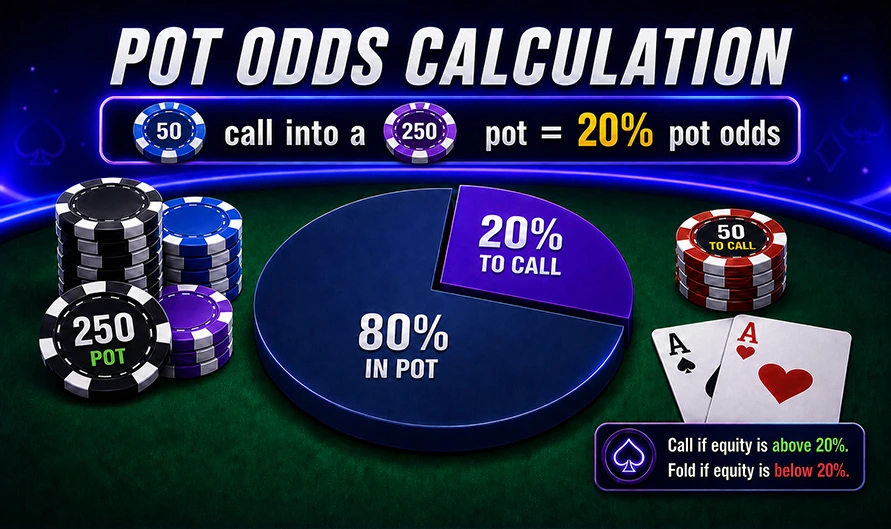 Pot odds are closely linked to the idea of bet sizing. Pot odds tell you the price of calling vs the amount you can win as a ratio or percentage. For example, let’s say you bet 50 chips and there are already 150 in the pot. That takes the pot to 200 chips.
If your opponent calls 50, the final pot will be worth 250 chips. We can use this number to calculate your opponent’s pot odds:
50:250 (i.e., 50 goes into 250 five times, which reduces down to 4:1)
or
50 call / 250 in the pot = 20% (50/250 = 0.20 x 100 = 20).
I find it easier to think in percentages when it comes to pot odds. So, in this scenario, your opponent’s pot odds are 20%. Conventional poker strategy states that you should call if your hand’s equity (chance of winning) exceeds the pot odds. So, if your opponent believes their hand has >20% equity against your range, they should call. If their hand has less than a 20% chance of beating your range, they should fold.
Not sure if a call is worth it? Plug the numbers into our poker odds calculator to see your exact pot odds before you decide.
How to Size Your Value Bets and Bluffs
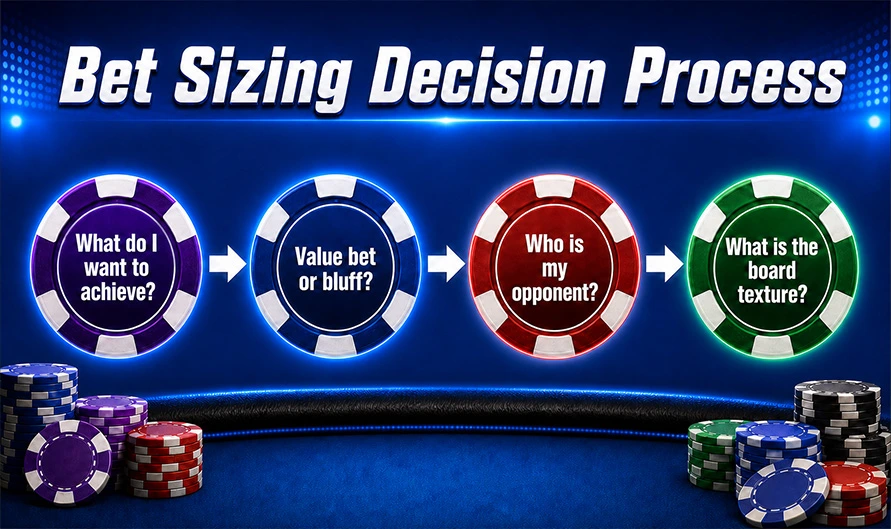 Based on this analysis, we can define some rules for value betting and bluffing:
- Value betting = you should bet the maximum number of chips someone will call when you’ve got a strong hand.
For example, if you’ve got a full house and you believe someone will call a pot-sized bet with a flush, that’s how much you should bet. This gives you maximum value for your hand.
In mathematical terms, the amount you bet should give someone the right pot odds to call. Let’s run through a scenario:
- You bet 50 chips into a 150-chips pot on the river with a full house.
- Using a free pot odds calculator, we know this gives your opponent 25% pot odds (50/200 = 0.25 x 100 = 25).
- Based on conventional poker theory, your opponent needs 25% equity (i.e., chance of winning) to make a profitable call.
Using the information you’ve collected throughout the hand, it looks like your opponent has 25% equity. So, in this scenario, you’ve made the perfect value bet. If you bet 25 chips, your opponent would probably call, but you wouldn’t have gotten maximum value because, based on our analysis, they would have committed more chips.
- Bluffing = you should bet the minimum number of chips required to make someone fold.
Bluffing is exactly the opposite of value betting. So, going back to our previous scenario, let’s assume we’re on the river and we believe our opponent has 25% equity against our range (i.e., their hand has a 25% chance of winning against our possible range of hands).
Assuming our opponent understands pot odds, we can bet any amount that gives them less than 25% pot odds. Betting 75 chips into a 150-chip pot would achieve this goal because it would give your opponent 33% pot odds (75 / 225 = 0.33 x 100 = 33). Why? Because your opponent’s hand doesn’t have enough equity against our range to call.
Bet Sizing Against Beginners and Skilled Poker Players
Everything I’ve said up to this point assumes that you’re playing against people who understand basic poker strategy. If you’re at a table with skilled players, then you should stick to the fundamental principles I’ve explained.
Use the Fundamentals Against Skilled Players
That means using a standard pre-flop raise size (between 2x and 3x) and adjusting your bets based on intent. For example, if you’re value betting, choose an amount that your opponent can call based on their possible range.
Then, once you’ve established a pattern, switch things up. So, if you always bet 65% of the pot when you’re value betting and 100% with bluffs, switch them around. I’m not saying you should switch the percentages permanently. Just do it a few times to keep people guessing.
Players who always bet the same amounts with specific types of hands are easier to read. I have a selection of bet sizes I use 85% of the time. These are my foundations. On top of that foundation, I mix in some different bet sizes approximately 15% of the time.
This makes me harder to read, which, in the long run, makes me harder to play against because people are never completely sure what type of hands I’ve got. Again, however, this only applies in situations where you’re facing skilled poker players.
Inelastic Ranges: Bet Big Against Beginners
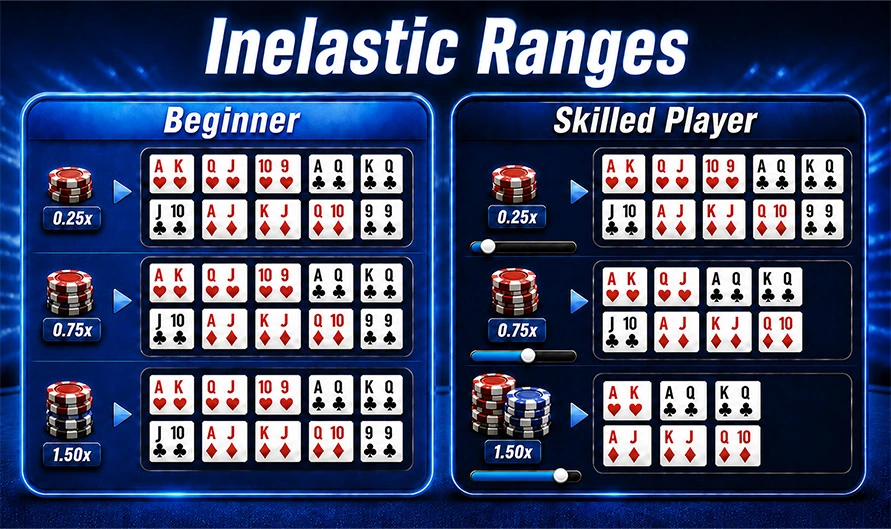 Against beginners, I rarely change my strategy because I know they’re probably not paying much attention to the amounts I’m betting.
This links to a concept known as inelastic ranges, which simply states that unskilled players have the same calling ranges, regardless of how much you bet. In other words, if someone is planning to call, they’ll do so if you bet 10% of the pot’s value or 150% of its value.
Because of this, it’s often OK to play your hands face-up against beginners. That simply means you can bet with your strong hands and fold weak ones. Let’s say you hit a flush. Don’t try to be clever and play it cool.
Instead, you should bet (or raise) as much as possible. For example, when I flop a strong hand or draw in Hold’em, and I know my opponent is a beginner, I’ll bet at least 85% of the pot’s value.
I do that because weak players almost always call when they’ve got a piece of the board, no matter how small. Therefore, the best way to get maximum value is to bet big and often. There will be times they fold. However, you’ll make enough money in the long run using this strategy because weak players call far more often.
Always Ask Yourself Why
While it’s fine to bet big when you’re up against weak players, that won’t work as you move up in stakes. That’s why you need to think carefully about the amount of chips you’re putting into the pot.
Always ask yourself this question before you bet: what do I want to achieve? If you’re value betting, choose the largest amount you think someone will call. If you’re bluffing, bet the smallest amount required to make someone fold.
Bet Sizing Checklist
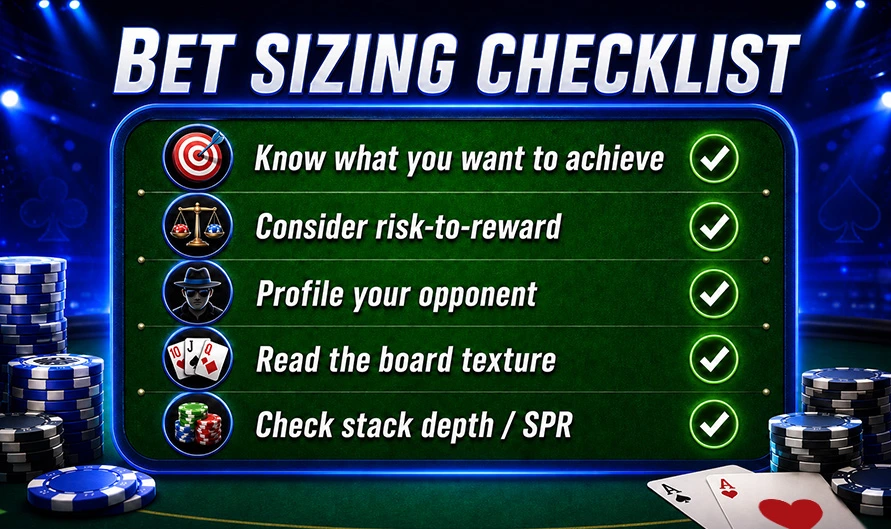 Now that I’ve walked you through the fundamentals of bet sizing, it’s time to put your knowledge into practice. The checklist below covers the main principles you need to consider before you place a bet:
- The amount you bet forces opponents to react, so always know what you want to achieve before putting chips into the pot.
- Betting too much compared to the pot and/or your stack increases the risk-to-reward ratio. Make sure you have strong hands when making big bets.
- Use conventional bet sizes 90% of the time, but don’t be afraid to break the rules when the situation allows, as it makes you harder to play against.
- Give players attractive pot odds when you’re value betting and unattractive pot odds when you’re bluffing.
- Beginners often have inelastic ranges, which means you can bet bigger than usual, as they won’t be thinking about the amount of chips required to call.
Keep those five points the next time you play poker online, and you’ll get maximum value from your value bets and your bluffs.
Frequently Asked Questions: Bet Sizing in Poker
Bet sizing is the amount of chips you put into the pot. Good bet sizing helps you get value, win more pots, and control how the hand develops.
Bet sizing matters because it affects whether opponents fold, call, or raise. It also changes pot size and stack-to-pot ratio, which influence your decisions on future streets.
Choose your bet size based on your goal, the board texture, the stack-to-pot ratio, and your opponent’s likely range. Bigger bets often work better when you want folds. Smaller bets often work better when you want calls.
On dry boards, smaller bets are usually better because there are fewer draws to protect against. Small bets can still get value while keeping weaker hands in the pot.
On wet boards, larger bets are often better because draws have more equity. Bigger bets charge those draws more and create more fold equity.
You should overbet when you have a strong nut advantage and want to put maximum pressure on your opponent. Overbets work best with polarized ranges made up of strong value hands and bluffs.
Stack-to-pot ratio, or SPR, is the effective stack divided by the size of the pot. It helps you plan how much money can go into the pot on later streets.
Usually, yes. In good balanced strategies, your bet size should depend on the situation rather than the exact hand you hold. That makes you harder to read.
Against beginners, bigger value bets often work well because they may call too wide or ignore sizing patterns. Against stronger players, your bet sizing should be more disciplined and situation-based.
The biggest mistake is betting without a clear purpose. Every bet should have a reason, whether that reason is to get called, get folds, or set up future streets.