


Aggression is at the heart of almost every successful poker strategy. From cash games to tournaments, there are times when it pays to take the initiative.
I’m not the first person to say that. Legendary pro Doyle Brunson was an early proponent of aggressive poker in his seminal book, Super/System. However, while Brunson’s book inspired a generation of aggressive online poker players, times have changed.
This guide walks you through the fundamentals of aggressive poker and how to implement it in today’s games.
Poker Strategy 101: What is Aggressive Poker?
Aggressive poker is when you take the lead in a hand by betting, raising, or re-raising. The counter strategy is known as passive poker, which involves limping, checking, and calling.
There are times when both strategies are useful. In fact, there are times when it can be just as good to play passively or aggressively. But, in general, it’s better to take aggressive lines if you’re a beginner because it puts you in the driving seat. This allows you to put opponents under pressure rather than the other way around.
For those who don’t know, a “line” in poker means the betting pattern you use during a hand. For example, if you bet pre-flop and bet again on all three streets, that’s your line. It’s also an aggressive line because you took the lead by betting at every opportunity.
Switching Gears: Aggressive to Passive
Before we move on, it’s important to note that you can switch gears during a session, or, indeed, a hand. You could start off aggressively by raising pre-flop and switch to a passive line on the flop.
The main reason for switching gears is that you’ve hit an unbeatable hand. For example, let’s say you raised pre-flop with A♦ K♦ and the flop comes 3♦ 8♦ 10♦. Unless your opponent is very loose or you think they’ve flopped a set, it’s probably best to check.
This gives them a chance to make a hand strong enough to call with. It also makes you look weak, which might make your opponent try a bluff. Either way, there’s nothing wrong with switching gears throughout a hand. In fact, it can be a good idea because it keeps players guessing.
Types of Aggressive Players
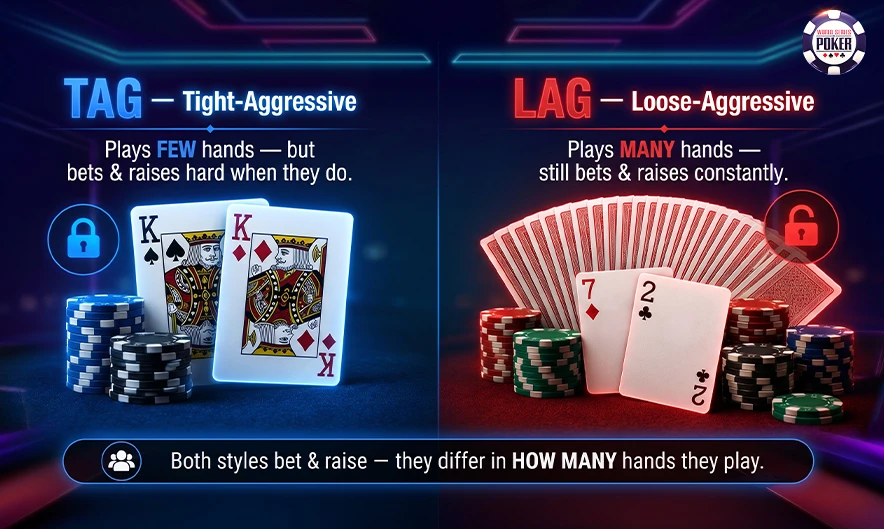
To play like an aggressive poker player, you need to be able to spot an aggressive player. Here are the two types of aggressive players you’ll come across in live and online poker games:
- TAG – TAG stands for Tight Aggressive. This type of player waits for strong hands, so they aren’t involved in many pots. However, when they decide to play, they almost always bet and raise/re-raise.
- LAG – LAG stands for Loose Aggressive. This type of player isn’t afraid to play a lot of hands. It doesn’t matter if they’ve got pocket aces of 7-2 offsuit, a LAG player will bet and raise/re-raise.
The style you adopt is a matter of personal preference. My top tip is to be a TAG. Focus on playing strong starting hands aggressively, and don’t step out of line until you’ve got more experience. Then, once you’re comfortable playing big pots with weak hands, consider being a LAG.
Eventually, when you can play like a LAG and TAG, you can mix it up. Play one way when you first ante up in a game, then switch it up. That’s how pro poker players stay one step ahead of their opponents.
Why Aggressive Poker Strategies Work
Playing aggressively is a great way to win pots because it puts people under pressure and increases the chances they’ll make mistakes.
Consider this scenario:
- You’re playing an online cash game. You have position on your opponent with A♣ 8♠.
- The board is A♥10♠Q♣3♣Q♥
- You’ve got two pair: A♣A♥ Q♣Q♥ with the 10♠ as your kicker
You believe your opponent has an ace too. In most cases, you will split the pot, unless your opponent has A-K, A-Q, or A-10. With A-Q, your opponent has a full house. With A-K or A-J, they have a better kicker. If they have any other ace, you split the pot.
The Action:
Your opponent places a bet, so it’s your turn to act. You’re not going to fold because you have a strong hand, so you have two options: call or raise.
Your Decision:
Calling is perfectly acceptable, but is it the best play? Let’s assume your opponent has already folded to river raises. We can also assume they’re a tight player who is relatively inexperienced.
Making an aggressive play could be the best move here because
- At worst, your opponent re-raises and you have to fold (because you’re most likely beaten). However, given what we know, they’re unlikely to do this unless they’ve got at least a set of queens.
- If they have an ace with a weak kicker, a raise might force them to fold. They may even fold an ace with a strong kicker if they believe you’ve got a queen.
Either way, raising gives you a chance to win the pot rather than splitting it. That’s the power of aggression in poker.
Five Aggressive Moves and When to Make Them
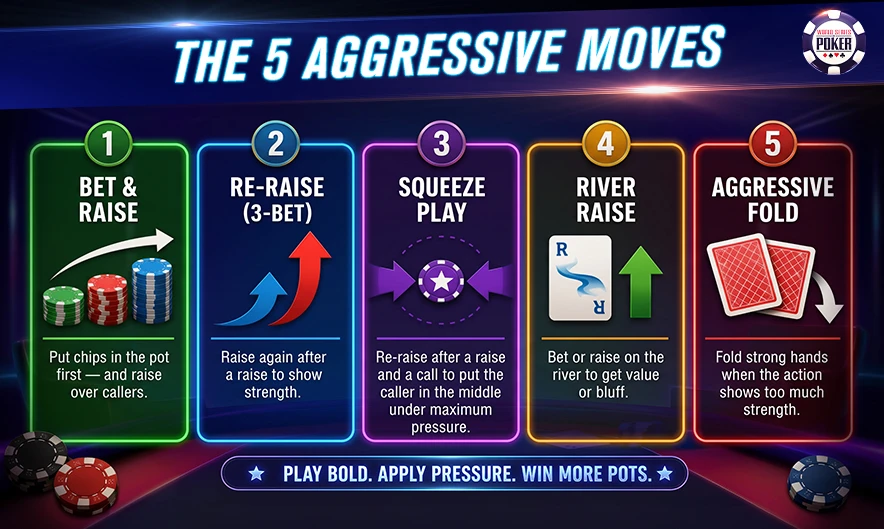
Mastering the art of aggression requires you to take the lead. There are various ways to do that when you’ve got a strong hand and when you’ve got a weak one. Based on my time in the game, these are the five best aggressive moves you can make in poker:
1. Bet and Raise
- When to bet and raise: with strong hands pre-flop and post-flop + when you want to bluff
- Which players to bet and raise against: all players
Betting and raising are essential poker skills. I remember talking to poker pro Barny Boatman in 2007 about Texas Hold’em. His advice to me at the time was this:
If a hand isn’t good enough to raise, it’s not good enough to call with.
The meaning behind his message is simple: play strong hands and play them aggressively by betting/raising rather than calling.
Taking this advice a step further, I recommend raising pre-flop and betting post-flop if you’re going to bluff.
Don’t call pre-flop or check post-flop because they’re signs of weakness. Bluffing is all about showing strength, and you do that by betting and raising. For a deeper dive into structuring a believable bluff, see our full guide on how to bluff in poker.
2. Re-Raise
- When to re-raise: with strong hands and as a bluff against tight players
- Which players to re-raise against:weaker players and tight players
The second most important move you can make when it comes to aggressive poker is re-raising. This move requires you to raise after a raise. Here’s an example:
Game= $1/$2 Texas Hold’em
Betting Round = pre-flop
Action
- Player A calls $2
- Player B raises to $8
- You re-raise $28
Raising an initial raise is incredibly powerful because you’re telling everyone that you’ve got a stronger hand than someone who’s already demonstrated strength.
The example above is what we call a three-bet. Someone calls, someone raises, then you re-raise. There have been three bets in total, which is why it’s called a three-bet. It’s also possible to make four-bets and five-bets.
A four-bet is even more powerful than a three-bet because you’re telling the table you’ve got a strong enough hand to beat the caller, the raiser, and the re-raiser.
In fact, when a player four-bets before the flop, it’s almost always an all-in move. If they don’t move all-in, they’ll put in at least 50% of their stack, which tells you they are going to put in the rest of their chips if necessary.
3. Squeeze Play
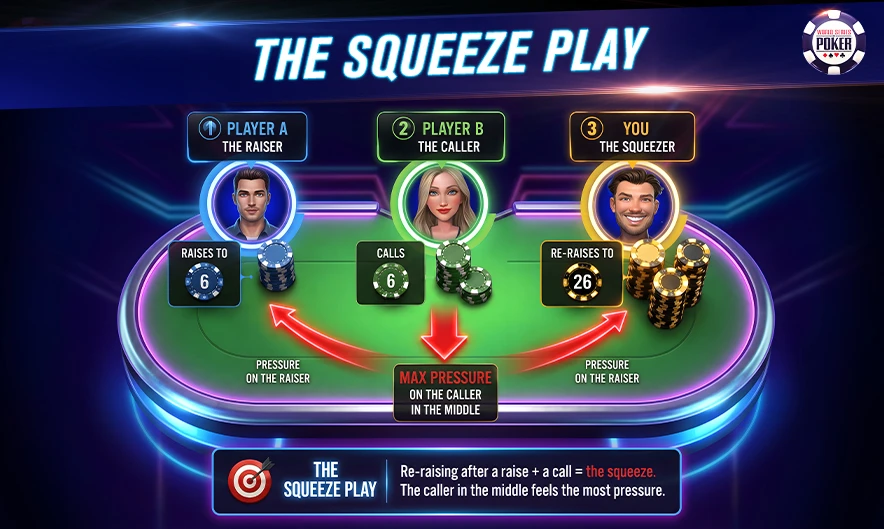
- When to make a squeeze play: pre-flop with semi-bluffs and bluffs
- Which players to make a squeeze play against: tight raisers and loose callers
The squeeze play is my favorite pre-flop move in Texas Hold’em. The concept is simple: you re-raise after a raiser and a caller. Here’s an example:
Game = $1/$2 Texas Hold’em
Betting Round = pre-flop
Action
- Player A raises to $6
- Player B calls
- You re-raise $26
There are two things happening here. Firstly, you’re showing strength as the re-raiser. You’re signaling to the table that you’ve got a stronger hand than the raiser and the caller.
Secondly, you’re squeezing the player in the middle. The theory behind squeezing a player is this:
- Player A is under pressure because you’re re-raising their raise. They’ll think you’ve got a very strong hand. They’ll also be worried about Player B, who could raise if they call. So, what we’ve got here is a situation where Player A is worried about two opponents, so they have to fold all but their strongest hands.
- Player B is also under pressure because they have seen one player raise and another re-raise. We can assume they don’t have a very strong hand because they called and didn’t re-raise. The only time this doesn’t apply is if Player B is trapping (calling to appear weak) with a very strong hand.
Based on this theory, a squeeze play works incredibly well if you do it at the right time. Based on my experience, the right time to make a squeeze play is when the original raiser (Player A in this example) is tight. It also helps if the caller (Player B in this example) is loose.
Here’s the theory as to why you want tight raisers and loose callers:
- Tight players tend to call re-raises or move all-in pre-flop when they’ve got pocket aces or kings. Because tight players will have more than these two hands in their raising range, there’s a good chance you can make them fold with a squeeze play.
- If the caller is loose, they’ve got a wide range, so the average strength of their hands is low. This makes it less likely they’re trapping with strong hands. So, when you put all this together, you get the perfect scenario for a squeeze play.
4. River Raise
- When to make a river raise: on the river
- Which players to make a river raise: beginners and tight players
Raising on the river is one of the most underused moves in poker. I first tried this move after listening to online poker legend Phil Galfond. He was talking about a conversation he had with another poker legend, Tom “Durrrr” Dwan.
Dwan is known for his aggressive style and questioned why Galfond wasn’t raising on the river. The premise is simple: if you think there’s a chance your opponent will fold, it’s worth considering a raise.
Let’s think about the situations where you’d want someone to fold on the river:
- When you’ve got the worst hand/you’re bluffing.
- When it’s a split pot.
- When you might have the best hand, but you’re unsure.
The first situation is obvious. You can raise someone’s river bet as a bluff. The second and third situations are less obvious.
There’s nothing wrong with calling if you think it’s going to be a split pot, but you’re losing equity if there’s a chance your opponent folds. By that, I mean you could win the entire pot rather than 50% of it.
Similarly, if you think there’s a 35% chance you have the best hand but a 50% chance your opponent will fold to a raise, it may be better to be aggressive.
Obviously, the action leading to the river matters. You need to tell a convincing story if you want someone to believe you’ve got a strong hand. However, if the timing is right, river raises can be highly effective because they take players by surprise.
Before firing that second barrel, check the odds with our poker odds calculator to make sure your fold equity actually justifies the bet.
5. Aggressive Fold
- When to make a squeeze play: the flop, turn, or river
- Which players to make a squeeze play against:against a very tight player
Aggressive fold is a term that’s often used when a tight player lays down a hand that almost everyone else would call with. In most cases, it’s meant as a joke, but it’s a perfectly legitimate play when you’re facing a tight player.
Here’s an example of when you might want to make an aggressive fold:
Game = $1/$2 Texas Hold’em
Betting Round = the river
The board: A♣ A♦</b 7♠ 7♥ 7♣
Pot</b = $50
Action
- Player A bets $30
- You raise to $75 with A♠ 3♥
- Player A moves all-in for $250
This is a tricky spot. You’ve got a full house (A♠ A♣ A♦ 7♠ 7♥), so raising is a perfectly valid move. However, Player A has moved all-in, which looks incredibly strong. Here are the possibilities to consider:
- Your opponent is bluffing. This is unlikely given the size of the pot and the amount you need to call.
- They have an ace, which means you both have a full house. But, again, they’re unlikely to make such a risky move when calling would be enough.
- They have a seven. Quads are rare in Texas Hold’em, but they’re not impossible. Also, the action suggests that Player A has the 7♦.
So, even though it’s hard to fold a full house, it could be the right move in this scenario.
Aggression is All About Timing and Context
Aggression is great, but you can’t be too aggressive. Skilled poker players wait for the perfect opportunities to make aggressive moves. They know aggressive moves are most likely to be successful when you’ve got the right cards, the right opponent, and the right image.
So, if you want to really master the art of aggression, make sure you assess each situation before you act. If you’ve got a strong enough hand, or your opponent is likely to fold because they see you as a tight player, be aggressive. If not, wait for another spot.
Here are three things to consider before you make aggressive moves:
-
Table Dynamics
It’s often a good idea to go against the norm when you’re playing poker. If everyone at the table is being aggressive, you should play defensively. If everyone is passive, be aggressive.
Take note of how often players are betting and raising vs. calling. The easiest way to do this when you’re playing online poker is to look at table stats and individual stats. Table stats can be seen in the game lobby or in the chat box when you’re playing.
For player stats, you need a heads-up display (HUD). Some online poker sites have inbuilt HUDs that show you how often players are putting chips into the pot (VPIP), raising pre-flop (PFR), and betting (Aggression).
For poker sites without HUDs, you can use third-party poker tools such as Holdem Manager and PokerTracker. These tools do the same job, which means they provide live statistics that tell you how active someone is.
-
Position
Aggressive poker moves are always more effective in position than out of position. That means you should be the last person to act. I’m not saying you can’t play hands aggressively out of position. However, it’s a lot harder.
Betting when there’s at least one person to act puts you in an uncertain spot. By that, I mean you don’t know if someone is going to raise. When you’re in position (aka last to act), you can dictate the action.
If someone bets, you can fold, call, or raise. If someone checks, you can follow suit or bet. The point here is that you have more control, which, in turn, means your opponent/s have less control. I like to say that you’re in a position of power that allows you to put maximum pressure on someone. That’s ideal when you’re playing aggressively.
-
Opponents
Aggressive poker strategies work in all contexts, but there are situations where it works better than others. In my experience, aggression works best in low-stakes games against weak players.
The caveat here is that 90% of your aggressive moves should be for value rather than as bluffs. Weak players rarely fold when they catch a piece of the board, so you need showdown value if you’re betting and raising. If you’ve got that, bet/raise as often and as much as you can.
If you’re playing higher stakes games against experienced players, aggression needs to be part of a bigger strategy. You can’t be aggressive all the time. In technical terms, you need to be balanced. This means switching between aggressive and defensive moves.
Don’t Swap Balance for All-Out Aggression
Picking up on my last point that you can’t be overly aggressive against skilled players, I wanted to discuss the concept of balance. Being balanced means you use a combination of aggressive and defensive moves.
You don’t need to have an even split. Personally, I use a 65/35 strategy, which means I play aggressively 65% of the time and defensively 35% of the time. You can use any mix you like, but make sure it’s somewhere fairly close to even.
Once you’ve established a baseline, you need to play similar hands two different ways. For example, if you play pocket aces aggressively pre-flop 65% of the time, you should play them defensively (by calling) 35% of the time.
If you weren’t balanced and simply went for all-out aggression, you’d be easier to read. For example, if raised pre-flop with aces 100% of the time and always went to showdown, observant players would notice this and react accordingly. That’s why you should balance your range.
Common Mistakes: 5 Things to Avoid When You’re Being Aggressive
Aggression is a great way to pressure other players and force them to make mistakes. However, because you often have to make large bets and raises, it’s easy to make mistakes yourself.
Here are five mistakes to avoid when you’re playing aggressive poker:
- Poor hand selection
I’ve seen way too many people overvalue medium and weak hands when they’re using an aggressive strategy. Don’t be too aggressive with hands like aces with a weak kicker, gutshot straight draws, and one pair. Save your aggression for aces with strong kickers, two pair or better, and open-ended draws. You can also play bluffs aggressively if you’re up against tight players.
- Picking on the wrong players
Some players just don’t respond well to aggressive moves. For example, if you’re facing an equally aggressive and skilled player, they’ll probably know when to call and when to fold. Similarly, if you’re facing a calling station, no amount of aggression will get them to fold when you’re bluffing. Therefore, you need to choose your targets carefully.
- Committing yourself with weak hands
The biggest mistake people make when they first learn to make aggressive moves is that they commit too many chips with marginal hands. In technical terms, they pot commit themselves in negative EV spots.
For example, let’s say you’ve got A♣ 2♥and the board is A♥ J♠ T♠ 5♠ . Betting over 50% of your stack on either the turn or river is a bad move for two reasons. Firstly, the pot odds will be almost too good for you to fold if an opponent goes all-in.
Secondly, even though you’ve got top pair, it’s a weak hand. Aside from aces with better kickers, someone could have a straight, two pair, or a flush, not to mention a strong draw. So, in this example, playing aggressively and pot committing yourself is a mistake.
- Being overly aggressive
Linked to the point about committing yourself with marginal hands is the idea that you can be too aggressive. The same way you shouldn’t do anything 100% of the time, you shouldn’t be betting and raising every single hand you play. It’s too predictable and risky.
- Not reacting to other players
The final mistake I’ve seen people make all too often is ignoring the reactions of others. Even inexperienced players will start to smell a rat if you’re always betting into them or raising when they bet. If someone changes their strategy, you have to do the same. Don’t assume you can bulldoze people forever. If they start playing back at you, switch to a defensive strategy for a while.
How to Play Against Aggressive Players
This article has focused on playing aggressively, but what happens when someone puts the pressure on you? There are two ways to handle aggressive players:
1. You can fight fire with fire
It’s often the case that aggressive players like to be in the driving seat. They don’t like being put to the test. So, if you can find a way to be more aggressive, like 3-betting, do it.
2. You can be defensive
An analogy I like to use to describe this strategy is a defensive tennis player who only focuses on returning their opponent’s shots. The defensive player is hoping their aggressive opponent will eventually make a mistake.
You can do the same in poker. Let someone think they’ve got the upper hand by folding when you’ve got weak or medium-strength hands. Then, when you’ve got a strong hand, set a trap and let them walk into it.
Summary: Your Pre-Aggression Checklist

Aggression at the right time can be highly effective. As long as you choose your target carefully and don’t become too predictable, it’s better to be aggressive than passive when you play poker online and live.
With this in mind, here’s a checklist of things to consider before you pull the trigger and play aggressive poker like Doyle Brunson:
- Be aggressive if you’re the first player into the pot by raising pre-flop. This puts you in charge of the hand. If you can’t be first in and you want to take control, raise pre-flop.
- You can be a Tight Aggressive (TAG) player or a Loose Aggressive (LAG) player. Both strategies are equally valid. The one you choose depends on how many hands you prefer to play.
- Timing matters. You can’t afford to be aggressive in every situation against every player. Ideally, you should be most aggressive when you’re in position (last to act) against weak or tight players.
- Don’t be aggressive all the time. Switch things up by playing the same hands differently. I tend to play hands aggressively 65% of the time and defensively 35% of the time.
- React to players around you. You can often beat aggressive players by being more aggressive. However, you should analyze each situation because there may be times when defense is the best strategy.
Keep these points in mind the next time you play, and you’ll be a scary player to play against in any situation.